You are currently browsing the category archive for the ‘Poet’s Life’ category.
Today the temperature is predicted to reach almost 50. For Wisconsin in February, that’s a rare treat. Any Midwesterner knows that this isn’t the real spring, just a preview of coming attractions, a teaser. But, it’s a bright, sunny day — a good day for a walk, notice the birds, and think about the coming year, not just clean the road-crud out of the garage. There’s a little smell of mud in the air, which makes me hope that the real spring is only about a month away, that soon we can peel off the layers, stretch, and open the windows.
I remember a passage from Toni Morrison’s The Bluest Eye, where Pecola is walking home from school on a similar false-spring day. She and her friend have balanced their coats up on to their heads, so they’re not really wearing them, but they don’t have to carry them either. I remember many walks home from school, doing the same thing, enjoying the warm-ish breeze.

Me at 3
The main theme of The Bluest Eye, is the cultural ideal of beauty (blonde, blue-eyed, white) shown through Pecola’s obsession with her Shirley Temple mug and her relationship with her distant mother and abusive father. Many girls felt (still feel?) the pain of not looking like the ideal. Although not as overt or racist, my red hair, green eyes, and freckles made my looks exceptional. As a child, all you want is to fit in and be accepted. Once an adult, I understood and came to prize my rare coloring, as I know Ms. Morrison came to value hers, too.
Poetry Speaks
A few months ago, I listened to Poetry Speaks, a book with great poets reading their own works and accompanying text. While reading along with the poets, I noticed most of the time they spoke words that were different from the published version of the poem. The more I write, the more I’ve come to understand why that is. Perhaps there are some writers/artists that can create and walk away from the product. Not me, nearly every time I review a poem, I change some word.
Most weeks I submit poems for my writing group to critique. Every time it’s pleasure and pain. They are wonderful, bright writers and are always kind with their criticism. They never fail to zing me on a poem that I knew wasn’t good enough — even I wasn’t happy with — like they did last night for my poem, The Idea of Home.
Another of the poems they reviewed last night is posted earlier on this blog under “What happened to the dress?” I weigh all their input. Some recommendations I use; some recommendations I just shrug off. Here is the latest version of that poem, new title (thank you, Susan), and all. Read the rest of this entry »
Speaking with a self-described starving artist recently, I wondered if pay influences the outcome of art. By art I mean, all forms of creative expression (painting, photography, music, writing, etc.). My initial response is yes, it does. For evidence I point to most artist’s second major work and the infamous sophomore curse. I could tick off many examples, but it’d be just mean to list them. I’m trying to decide, though, if it’s the money or the fame (ego) that kick-starts the curse. Perhaps money and fame have a synergistic effect on the artist that can’t be separated or replicated in a control study. Maybe someone will point-out an example where an artist received loads of money and fame from a first work and their subsequent work was better than the first.
There are many examples where the second work is sub-par (that bar was pretty darn high, though), but the third and later are excellent, and the artist goes on to produce a great body of work. Is J.K. Rowling an example? Probably not, since she had the entire series of Harry Potter mapped out before the first book was published.
Many writers I know state a goal of being able to live off their writing and leave their “real jobs” someday. Now that I’ve started submitting poems for publication (ah! the fame of a literary journal!) and the reward of pay or contest winnings, I wonder how my own writing will be influenced once I get paid for a poem. I keep a detailed listing of initial draft dates, final draft dates, and submission dates. Of course, I can not be a legitimate experiment because of my beliefs that pay will influence me and my awareness of the issue (Heisenberg principle at work).
Guess we’ll just have to wait and see.
On my walk this morning I thought about a line I had read recently, ‘As you sit on the hillside, or lie prone under the trees of the forest, or sprawl wet-legged by a mountain stream, the great door, that does not look like a door, opens.’ Stephen Graham, The Gentle Art. (I pulled the book out to get it exactly right. My memory isn’t THAT good.)
The author directed the reader to map a list and a map of his[sic] wild places. Some of the places I’ve found a door include: the Ely woods behind where we lived when I was about 13 — my first (and favorite) place to escape; the road out of Kaiserslautern, B37, where I touched a man’s hand that sparked back to mine; the wooded stretch along the White River and Allisonville Road, which held the door to forgiveness; the ancient tree in the graveyard in Knightstown, the tree in Madison that talked to me; and many more. I’m sure I’ll have to come back to this and add ones I remember later.
These are all places, marked by me as a moment when I saw a door and went through it and changed. My holy places are such only because of the significance I give them. Seeing these doors requires an awareness (the potential) to accept whatever the moment may bring. These moments always bring something beyond what I could have imagined including their own fractal qualities: each door will open to others.
At the first of the month, when I pay my bills, I make a charitable contribution first. I have some automatic deductions, but I enjoy the hands-on process of choosing where and to whom I donate. Today I made a donation to Modest Needs. They have a search tool that lets you find a case by location or type. I found a person asking for assistance paying a hospital bill. In the title he wrote, I feel like Sisyphus. On that alone, I made a donation. Anybody who can make a literary reference like that deserves something. And, it could be worse — he could feel like Prometheus.
In order to be published, one must send out poems. For me, it took a deliberate decision to submit and submit regularly. It sounds easy, but it’s not (at least for me it wasn’t). I’m not refering to the logistics: the SASE, the big envelope, the copies, the submission check, the cover page, and whatever else they may want. The hardest part of the decision is the risk of rejection. They may as well as you to include a vial of blood or a non-vital organ, right? All your friends love your writing; your writing group is supportive and encouraging. However, they still give you feedback at a very direct and personal level. Literary journal reviewers and judges just see you as another sheaf of poems in a huge stack. They never see your dimples and big green eyes. Their appraisal isn’t colored by the fact that you helped them move. They read your poem and, if they like it, it goes in the pile of possbilities. If not, it goes in the recycling bin.
I’ve read that one shouldn’t try to second-guess what the board will want — it changes frequently. I’ve found that reading past winners only prods my insecurities. I just look at the date it’s due, gather and print what they want and schlep over to the post office. The other choice still stands — just write for yourself and put the poems in boxes and dressers all over your house, a la Emily Dickinson. Don’t even show them to anyone. But if you do show them to someone, it’s disingenuous to refrain from submitting them for publication. You have something to say, and poetry is your megaphone.
That said, I sent a submission to The Poetry Center of Chicago last week and one to the Madison Review this week. What have you sent out lately?
I have more difficulty writing a poem about someone very close or very dear to me than any other subject. I have been working on one person’s poem intermittently. It’s gone through three major them shifts and viewpoint shifts. Only one line from the original draft has survived. I’ve learned to sacrifice lines I love for the greater good of the whole poem (damn! there’s a poem idea…).
I’ve been trying to understand why poems like this are such a challenge for me. Maybe I have too much to say and can’t narrow down the viewpoint or the theme. Maybe I’m still standing too close and can’t get far enough back to see or feel what to write. Maybe I can’t separate the me from him yet. You’d think I could. In real-time, it’s been years; in my mind, well, that’s the magic of memory.
I am in awe of the greatest poets’ work like Yeats’ great poem, “When You are Old”. I tear-up every time I read the second stanza. Can’t touch the master.
When You are Old by William Butler Yeats
When you are old and gray and full of sleep
And nodding by the fire, take down this book,
And slowly read, and dream of the soft look
Your eyes had once, and of their shadows deep;
How many loved your moments of glad grace,
And loved your beauty with love false or true;
But one man loved the pilgrim soul in you,
And loved the sorrows of your changing face.
And bending down beside the glowing bars,
Murmur, a little sadly, how love fled
And paced upon the mountains overhead,
And hid his face amid a crowd of stars.
Working on my poem about stones and choices, my mind went tripping down the road of Ophelia and her drowning. I had to pull out the dumbbell-size Riverside compilation and re-read that part of Hamlet. In school I took a seminar that read the folios, but that’s been more than (cough!) twenty five years ago. Re-reading the Shakespeare made me think I might write this poem in iambic pentameter, but I got past that foolish thought quickly.
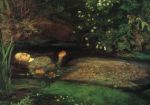
Millais' well-known Ophelia
When the queen tells Laertes about Ophelia’s death she blames it on a combination of Ophelia’s girlish foolishness picking flowers and climbing trees when a malicious tree branch wouldn’t hold her, so she fell into the river. This was certainly a way to ensure she was buried in hallowed ground, as suicide was a sin. In the next scene, the clowns as gravediggers talk about how the rich get away with shading and spinning the truth, and the poor can’t. Of course, what’s not talked about and scholars have targeted, is whether it was murder and was Ophelia pregnant. Shakespeare gives hints with Hamlet’s treatment of Ophelia, the queen’s elaborate story, etc.
What’s missing, too, is a scene with the servant(s) who found her, pulled her body out of the river, and carried her back to the castle. I plan to build the poem on these characters and the off-stage action in the great tradition of Tom Stoppard’s Rosencrantz & Guildenstern Are Dead. I should be so skilled!
I’m working on a poem about choices, using stones as messengers and emblems. Unless the poem comes to me fulll-term birth, I usually write down every random thought for the idea.

Stone with Chrysicolla vein
I carry a few stones with me all the time in my pack. One is a crystal one of reading students found in Arkansas, another is a lovely, smooth stone with a vein of Chrysicolla.
I have three geodes from Bloomington, IN (the terminal moraine), near where I used to live, that sit on the porch and are now buried under snow with the porch frog. I have my reading rocks to manage the summer breezes. Brad brought me back a big chunk of alfastein from Iceland. I have a piece of slickensides I picked up at the San Andreas Fault during a college geology class, pacific plate side. I’m remembering literary references to suicides with stones in their pockets to weigh them down in the river, overcome the survival instinct. I’ve seen rocks piled up into cairns beside paths at Buddhist monestaries, rocks shaped into arrows, rocks formed into walls, homes, chimneys. Stones are gravemarkers. David killed Goliath with a stone. Stones ‘grow’ albeit very slowly. I’m enamored of the inuksuits, but I’ve already written them into another poem.
I’m feeling that the way to go is to write about choices, rocks picked up, kept, others discarded. As soon as I have it complete, I’ll share it.
Have you thought about how you remember or how your memories are stored/retrieved? I found out recently that I have (store? retrieve?) observer memory. Most people have field memory. With field memory, if you recall an incident, the viewpoint is as if you/your eyes are a camera. As someone with observer memory, I see myself as if from a third-person point-of-view. I can see my whole body.
Now, I just assumed everyone’s memories looked like this. Researchers must have assumed this as well, since identifying these different memory types is relatively new. I found out when I asked my niece (PhD candidate in Psychology at OSU) for a term I had heard in passing (observer memory), but I thought this was just what psychologists called this third-person phenomenon for everyone. I polled my sisters, brother and several other random people around me. All of them have field memory. Who knows why mine is different? Not me.
Memory is notoriously fallible and completely point-of-view based. As a culture we have a disconnect, we trust our own memory and, therefore, give significant weight to eye-witness testimony. Cops, however, don’t give it a lot of value.
Here’s a link to a compilation of scholarly docs: http://www.phil.mq.edu.au/staff/jsutton/PointofView.html
 Poetiosity