Milwaukee Museum of Art

Milwaukee Museum of Art

I’m realizing I need to treat writing more like a job and set aside writing time whether I’m feeling inspired or not. Without doing that, I’m not writing as frequently as I do in the winter.

Over the weekend, I visited the Milwaukee Museum of Art. It was bigger and had a more comprehensive collection than I expected. It has a large modern art collection, which I love. It also has a great building and location right on the lake. Walking around in the museum, I had to stop and take notes a couple of times when inspiration and ideas came to me. I’m going to have to sit out in back and write every evening as dusk falls. Now if it would just be warm enough to do that — 50 degrees (even though it’s June) doesn’t quite make it summer evening.

I had no big plans for this weekend except napping. Reading goes well with napping; you just don’t get a lot of reading done. Deliberate naps are better than accidental ones. Accidental naps leave your neck cricked and drool running out the corner of your mouth, like the old men left in the nursing home hallway. Deliberate naps require first a decision, then a pillow and an afghan (ideally, home-made). They require you to be horizontal. Cats are optional.

It’s noon Sunday now, and still relatively quiet around the neighborhood. One neighbor was painting a small privacy fence with an electric paint sprayer, but she’s done now. For me, quiet is essential to a nap (all sleeping actually). I’ve made lunch, updated a poem with a thought from late last night, and crossed off my few Sunday tasks. Once I post this I’m off to the hypnagogic state.

I’m reading stories today in preparation for my writers’ group next week. I started to wonder why we choose what we do to write about. This week has has some various offerings: one story is an adventure, replete with weapons. Another story tells of a retired couple’s “adventures” wintering in Mororocco. One writer tells the deeper history of Lincoln’s early trial lawyer days. Another has written a science fiction creature story. Most of the writers stick to a chosen genre.

I tend to write poems about what strikes me emotionally or whatever random thought drops into my head. I can’t see myself writing historical or science fiction or fantasy unless it’s a class assignment. That would be a big mental change-up for me. Which is probably why a teacher would set those assignments. I’ll have to ask the other writers what drew them to their chosen genre. Did the feel compelled? Was it a choice? I read a lot of different genres, although I prefer contemporary fiction most often. Does your writing choice align with your reading choice?

A quick google-wiki-research shows that the phrase has biblical origins, Acts 12:23, “And immediately the angel of the Lord smote him, because he gave not God the glory: and he was eaten of worms, and gave up the ghost.” In that reference, I take it mean giving up your spirit or soul. Colloquially, I think it has come to mean completely giving up — in whatever context.

Origins of the phrase notwithstanding, I’ve just realized that I DO believe in ghosts. Maybe not Charles Dickens ghosts or Patrick Swayze ghosts or Ghost Whisperer ghosts, but ghosts nonetheless. I heard the phrase, “he gave up the ghost,” and wondered about its origin and then, that moment later, thought, “You have ghosts you won’t give up.”

There’s a poem in there.

His Holiness The Dalai Lama

His Holiness The Dalai Lama

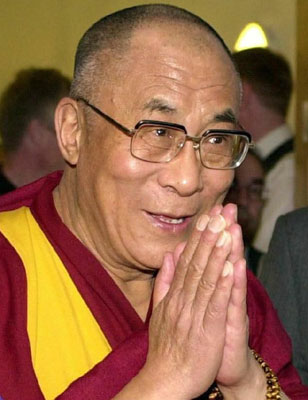
What would the Dalai Lama do? This little tongue-in-cheek reference to the WWJD bracelets that were popular several years ago — came out of a conversation with a courageous friend, Debbie, when she experienced feeling powerless. The actual incident-story is tragi-funny on its own, but its real value came after we dissected it and Debbie’s feelings. I call her courageous because I believe it took guts for her to reveal her pain and vulnerability to us. The end result of the hash and re-hash resulted in our awareness that there was a point, long before the critical point, where Debbie was aware that something was wrong. She knew this just from her feelings. What would the Dalai Lama do? He never would have gotten himself in that situation in the first place. He would have acted at the first awareness. Now the phrase has become a shortcut joke for us, but the message is still very powerful and reminds us to trust our feelings and act at the first sign — not wait until the situation becomes critical.

Last week I started reading the Dalai Lama’s most recent book, Becoming Enlightened. I normally read books like this very slowly, a chapter at a time, or a little bit each morning. I enjoy them most when they can sink in gradually. Reading them slowly lets me absorb and use the material as I read it. Seems I can handle only one bite at a time with this book. I don’t understand it. (That gets my ego in an uproar: I’m smart, I’ve read a lot of books like this before, It must be the language he uses, It’s the translation syntax, etc…) I read only one or two paragraphs at a time, read them again, then have to stop because my brain has just shut off. Well, not completely. There is also a little voice that says, “You just don’t want to do what he’s saying, that’s why you keep saying, ‘I don’t understand this.’ “

So, WWTDLD? Sigh. I think he’d ask for help. I think he’d dig into what that little voice is saying.
I’ve written in a previous blog how much I enjoy the HBO show, Russell Simmons Presents Brave New Voices. I highly recommend it — geez, there’s so much tripe on television, it’s great to see a show that offers so much. It extolls poetry as a way of bringing focus to young writers’ lives, it brings performance poetry to new heights, and it shows how hard it is to write a really good poem. What are you doing still reading this? Go watch an episode! Brave New Voices.

I’ve been listening to the mentors on the show and taking their advice for myself. They don’t hold anything back when they talk to these kids, but it’s great advice to all poets: open up and write your emotions, be clever, write outrageous metaphors, and be true to yourself.

The other day one of my friends told me he visited my blog, “po-atrocity.” Or maybe it was “poe-strosity.”

I love you, too, sweetie.

I was writing a poem recently and used a crayon-colors metaphor, so I went to the crayola website to validate the names of the colors in my memory. The box of 64 used to be the top of the crayone line — the compact box with the built-in sharpener and three tiers of crayons. Now there are containers with 96, 120 and 150. Compulsives like me would love the “twistables” crayons, each with its own auto-sharpener.

all_crayons

There are new gem tone colors (like lapis lazuli), colors that have been retired (bye-bye thistle), and colors that have been renamed (e.g., flesh is now peach (logically, most of the skin color on this planet isn’t that peachy color)). Some of these color names were my first introduction to great words: raw umber, mahogany, burnt sienna, goldenrod, and periwinkle — to name a few.

I may just have to go out and buy myself a crisp, new box.

My idea of how most people use Twitter is to ascertain or disseminate completely useless information, i.e., “where are you?” or “what are you doing?”. Not unlike most of the cell phone conversations I’m forced to endure in public. Anyway….

Twitter haiku is available now on Twiku. Some are a worthwhile read… some, not so much. Still, it’s more poetry moving through the universe, and that is a very good thing.

If you enjoy modern, spoken poetry (like HBO’s Def Poetry Jam), you’ll enjoy Russell Simmon’s new show, Brave New Voices.

The show is part documentary, part performance, all engaging. The show’s page has links to the selected poets’ full performances, since they’re edited for the documentary. Some of these kids are amazingly talented and insightful. Most of the poems will stand on their own without their charismatic performers. Even if you don’t subscribe to HBO, you can see the shows on HBO.com. Watch it.